28 July 2026 | Evershine Team | Buyers Guide
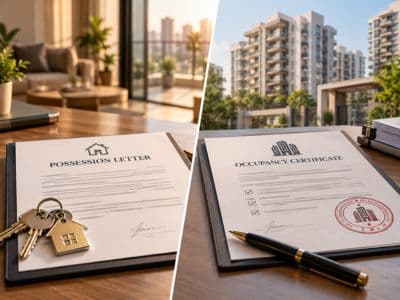
Most buyers focus on the day they get their keys. What they do not always focus on is the paperwork that comes with it. Two documents in particular tend to create confusion at this stage: the possession letter and the occupancy certificate. They sound similar. They arrive around the same time. But they serve entirely different purposes, and mixing them up can be an expensive mistake.
What Is a Possession Letter?
A possession letter is a document issued by the developer to the buyer. It formally invites the buyer to take physical possession of the completed unit.
It is the developer saying: the flat is ready, here is your handover. The letter typically states the possession date, any pending dues to be cleared before handover, and the condition in which the unit is being handed over.
The possession letter is an agreement between two private parties: you and the builder. It does not involve any government authority.
What Is an Occupancy Certificate?
An occupancy certificate, often called an OC, is issued by the local municipal authority, not the developer. It certifies that the building has been constructed as per the approved plan and meets all statutory requirements for habitation.
In Mumbai and its surrounding areas, this is issued by the Brihanmumbai Municipal Corporation or the relevant local body. The OC confirms that the structure is safe, the basic infrastructure is in place, and the building complies with all applicable codes.
Without an OC, a building is technically not approved for residential use. That is not a technicality. It has real consequences.
Why Both Documents Matter
The possession letter tells you the builder is ready to hand over.
The OC tells you the government certifies that the building is legally fit to live in.
You need both. A possession letter without an OC means you are moving into a building that has not yet received statutory clearance. Utilities like piped water, electricity connections, and sanitation may not be legally activated without an OC in place.
The Risks of Moving in Without an OC
Buyers who accept possession without an OC take on a burden that should not be theirs to carry.
No legal water or electricity connection. Civic bodies can refuse to provide official connections to buildings without a valid OC. Residents end up depending on temporary or informal arrangements, sometimes for years.
Complications in resale. When you eventually sell the flat, the absence of an OC becomes the first question a careful buyer will raise. Banks financing the new buyer may refuse to process a loan on a property in a building without OC clearance.
Risk of demolition or penalties. Unauthorised structures, or those built beyond the approved plan, may face penalties or even demolition orders. An OC is the clearest evidence that the building is on the right side of the law.
Legal complications under RERA. Under the Real Estate (Regulation and Development) Act, developers are required to obtain an OC before offering possession. Accepting possession without it may weaken your legal standing in any future dispute.
The Right Order of Events
In a properly managed project, the sequence is clear.
The developer completes construction, applies for and receives the OC from the municipal authority, then issues possession letters to buyers. Buyers then take handover, complete their registration, and move in.
In practice, some developers issue possession letters before the OC is in hand, asking buyers to take possession provisionally. This puts the buyer in a legally grey area. It is always worth asking your developer for the OC before accepting the possession letter.
What to Check Before Accepting Possession
Before you sign the possession letter and collect your keys, there are a few essential verifications.
Ask for the OC in writing. If the developer says it is applied for but not received, get a written commitment on when it will be obtained.
Check the completion certificate as well. This is separate from the OC and confirms that construction has been completed. Both documents should be in place before handover.
Inspect the unit thoroughly. The possession letter should note any pending work or defects that the builder commits to rectifying. Get this in writing.
Verify that all dues, including stamp duty and registration, are accounted for in the handover documentation.
Why the Developer's Track Record Matters
A builder who consistently delivers projects with all clearances in place is not doing anything extraordinary. They are simply doing what they committed to.
Evershine Builders has followed this approach since 1960. The group's standard has always been to complete every statutory clearance, including the OC, before handing over possession to buyers. That commitment to process is what separates a trustworthy developer from one who leaves buyers managing incomplete paperwork long after moving in.
Buyers also benefit from having digital access to key project documents, including clearance records, throughout the home-buying process, so nothing is left uncertain at the time of handover.
Browse the ongoing and completed projects by Evershine Builders or learn more about the group's legacy of transparent delivery on the About Evershine page.
Frequently Asked Questions
1. Can I move in if I have a possession letter but no OC?
Legally, it is risky. A possession letter is a private agreement between you and the builder. Without an OC from the municipal authority, the building has not been certified as fit for habitation. You may face issues with official utility connections, resale, and bank financing for future buyers.
2. Who is responsible for obtaining the OC?
The developer is responsible for obtaining the occupancy certificate from the relevant local body. Under RERA, possession is to be offered to buyers only after the OC has been received. If a developer is offering possession without an OC, buyers should seek written clarity on the expected timeline.
3. Is a completion certificate the same as an OC?
No. A completion certificate confirms that the building has been constructed as per the approved plan. An occupancy certificate goes further: it certifies that the building meets all conditions required for lawful habitation. Both are important, and both should be in hand before possession is accepted.
4. How do I verify if a building has an OC?
You can ask the developer to share a copy of the OC directly. In Maharashtra, you can also check with the local municipal authority or on the relevant government portal. A legitimate OC will carry the official stamp and reference number of the issuing body.
5. Does an OC affect my home loan?
Yes. Banks and housing finance companies assess the OC status of a building before processing loans, especially for resale transactions. A missing OC can delay or derail loan approvals for future buyers of your property. It also affects the lender's ability to offer financing on the original purchase in some cases.

Established in 1960, Evershine Group has shaped a six-decade legacy of trust and excellence. Renowned for creating nature-inspired homes with modern amenities, we deliver more than promised, offering middle-income families an aspirational lifestyle. Our focus on quality, innovation, and customer satisfaction makes us one of Mumbai's most trusted real estate developers.
ADDRESS
215, 2nd Floor, Veena Beena Shopping Centre, Gurunanak Road, Bandra (West), Mumbai, Maharashtra 400050
© copyright reserved 2026
Privacy Policy


